2012 英语一
Directions
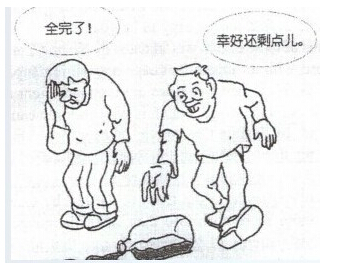
Write an essay of 160-200 words based on the following drawing. In your essay you should
- describe the drawing briefly
- explain its intended meaning, and
- give your comments
You should write neatly on ANSWER SHEET2.(20 points)
Sample
In the picture, we can see a bottle full of water has fallen, and half of the water in it has been spilled. The man on the left looks frustrated and says it is all over, while the man on the right tries to lift the bottle, saying that fortunately, there is still some left. Obviously, what this cartoon wants to express is that different people have different mindsets in the face of the same thing.
Sentences
- In the picture, we can see...
- Obviously, what this cartoon wants to express is that...
- different people have different mindsets in the face of the same thing/situation.
Vocabularies
- spill v. 溢出,撒出
- look frustrated v. 看起来沮丧
- mindsets n. 思维模式,心态,倾向
- in the face of sth. 面对...时
Supplement
- 描述时,先因后果(先写瓶子,再写反应)。
- 左右分开进行秒数,中间用while连接(若转折,形成对比)
Faced with the same situation, pessimists and optimists have completely different answers. Most people will think that optimism must be better than pessimism, because, in the face of the unknown, optimists tend to see opportunities while pessimists tend to see risks. Optimistic people look forward as hope and backward as experience. The pessimist looks confused in front and hurts backward. However, both pessimism and optimism are human instincts. Pessimism and optimism are not absolutely good or bad, nor are they absolutely right or wrong. Optimism can make us be unexpectedly rescued from a desperate situation, and pessimism can stop us from being hurt. An extra amount of optimism in adversity will get us out of trouble. More pessimism in prosperity makes us not arrogant and move forward better and steadily.
Sentences
- Faced with the same situation, A and B have completely different answers.
- Optimistic people/Some people look forward as hope and backward as experience. The pessimist/Some people looks confused in front and hurts backward.
- sth. be human instincts.
- A and B are not absolutely good or bad, nor are they absolutely right or wrong.
- stop sb. from doing sth.
- An extra amount of sth. = more sth.
Vocabularies
- pessimists n. 悲观主义者
- pessimism n. 悲观主义
- optimists n. 乐观主义者
- optimism n. 乐观主义
- optimistic adj. 乐观的
- adversity n. 逆境
To sum up, we should have a more understanding and tolerant attitude, and try to look at the problem from a different perspective. It's not wise to blindly belittle pessimism or pursue optimism. The combination of pessimism and optimism constitutes a complex human nature.
Sentences
- To sum up, we should have a more understanding and tolerant attitude, and try to look at the problem from a different perspective.
- It's wise/not wise to do sth.
Vocabularies
- belittle v. 轻视
2012 英语二
Directions
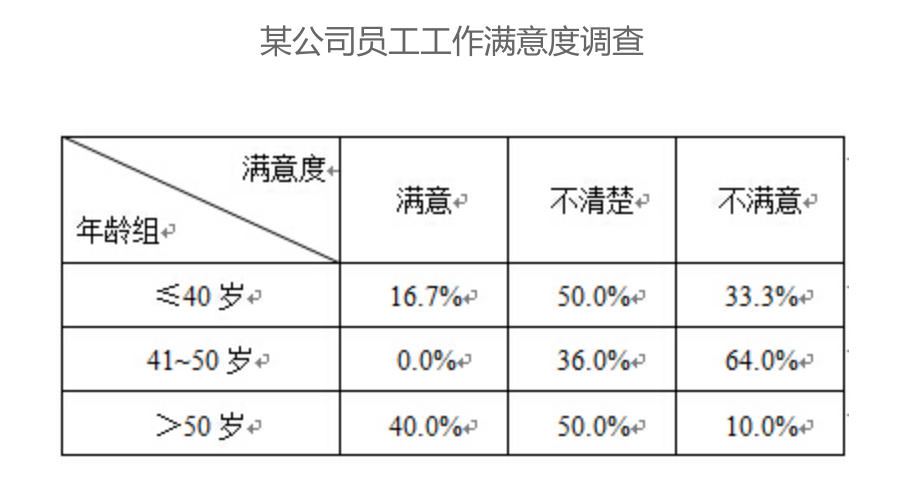
Write an essay based on the following table. In your writing, you should
- describe the table, and
- give your comments.
You should write at least 150 words. Write your essay on ANSWER SHEET 2. (15 points)
Sample
The chart describes the satisfaction of employees with work from the age dimension. In three age groups, employees over the age of 50 are more satisfied with their current job than those under the age of 40. It is surprising, however, that workers from the 41 and 50 age range have zero satisfaction with their current job. Besides, a considerable proportion of employees in any age group are not sure whether they like their jobs.
Sentences
- It is surprising, however, that...
Vocabularies
- dimension n. 维度
- a considerable proportion of... 很大的部分
Supplement
- 一串数字,只拿最大的和最小的对比,不需要遍历
How did this difference occur? It can be reasonably explained from the following aspects. First, employees over the age of 50 no longer have the same vision for the future as young employees, and can better understand their value, which increases their job satisfaction. Second, workers between the ages of 41 and 50 are relatively mature, and this age group also has more social and family responsibilities, but a meager salary makes it difficult for them to approve of their current job. Third, young people have more expectations for companies and jobs, so their satisfaction is slightly higher than that of employees between the ages of 41 and 50. As for nearly half of employees, it is not clear whether they are satisfied with their work because many people do not regard work as a way to achieve self-worth, but only as a tool for making money.
Sentences
- How did this difference occur?
- It can be reasonably explained from the following aspects.
- sb. have/has more social and family responsibilities.
- young people have more expectations for sth.
- many people do not regard work as a way to achieve self-worth, but only as a tool for making money.
Vocabularies
- meager adj. 小的,瘦的,贫乏的
- As for... 至于...
- achieve self-worth 自我价值的时限
Frankly speaking, companies should seriously consider the current situation and take effective measures to improve employees' satisfaction so as to enhance the companies' competitiveness. The company should provide different learning opportunities and promotion channels for employees at different stages. At the same time, companies should establish fairer incentive mechanisms to create a good competitive atmosphere to promote their progress.
Sentences
- Frankly speaking, companies/government should seriously consider...
- take effective measures to do sth.
- At the same time, companies should establish fairer incentive mechanisms to create a good competitive atmosphere to promote their progress.
Vocabularies
- incentive adj. 刺激,奖励